WordPress's Market Share Is Slipping. Here's What It Means
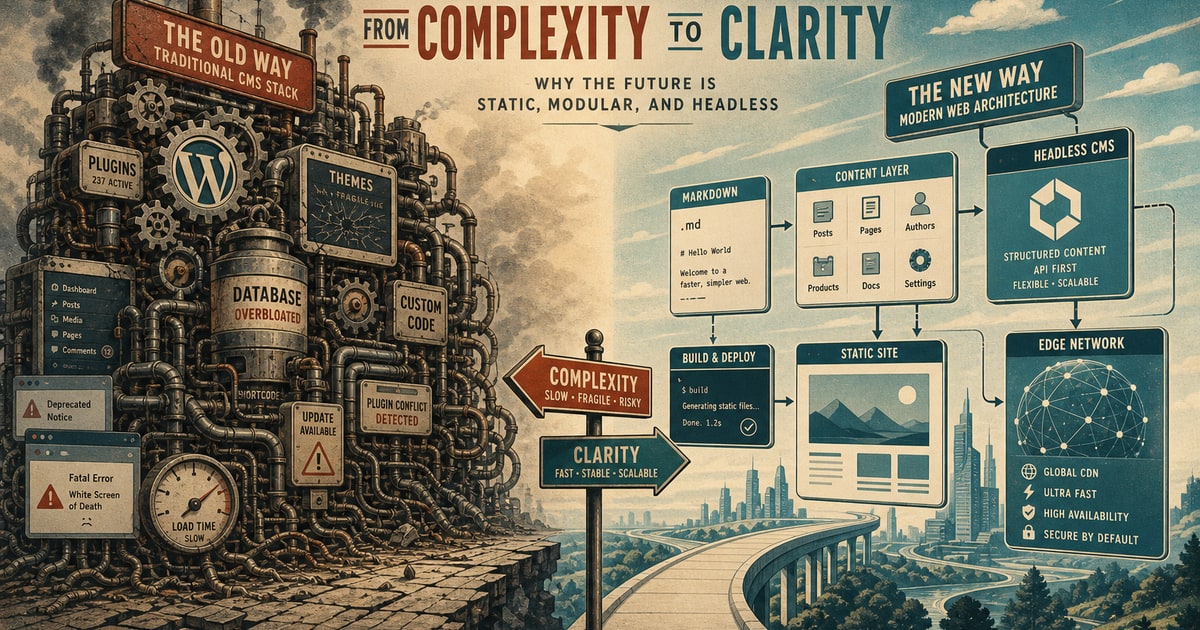
The number itself sounds minor. WordPress peaked at 43.6% of all websites tracked by W3Techs in mid-2025 and has since dipped to 42.2%. Search Engine Journal and Digital Marketing Desk both flagged the data, and both pointed to something more important than the drop itself: the platforms gaining ground are not beginner builders like Wix or Squarespace. They are static and hybrid frameworks, Astro among them, chosen deliberately by developers who no longer accept the CMS default as the right starting point.
That context matters more than the percentage. WordPress did not begin losing ground because something trendier appeared. It began losing ground because years of plugin sprawl, theme lock-in, and database-dependent rendering created a practical ceiling for performance-focused work. Developers who spent enough time inside the ecosystem reached the same conclusion. You can optimize WordPress extensively, but you are optimizing against its architecture rather than benefiting from it.
What a 1.4% Shift Actually Represents
At the scale W3Techs measures, 1.4% represents millions of sites. These are not casual experiments. They are rebuilds, migrations, and new projects launched with different assumptions. The shift is happening where performance, security, and long-term cost actually matter. Clients are asking better questions about Core Web Vitals, infrastructure overhead, and maintenance risk. Those questions lead to answers that increasingly move away from a default WordPress stack.
Concepcion Design reached that same inflection point after roughly a decade of serious WordPress development. The decision was not reactionary. It was comparative. The same effort required to properly harden and optimize a WordPress site, stripping themes, managing plugin conflicts, replacing page builders with custom blocks, consistently produces a better outcome when redirected into a purpose-built Astro or Next.js architecture. The resulting sites are faster, leaner, cheaper to host, and structurally simpler to maintain.
A Deliberate Shift in 2026
In 2026, Concepcion Design is no longer positioning WordPress as a default recommendation. In most cases, we actively steer clients away from it.
The replacement is not a single tool but a different approach:
- Markdown-first static builds for sites that do not need a database at runtime.
- Headless CMS architectures, including Payload 3, when structured content and editorial workflows are required.
- Deployment to edge CDNs where performance is inherent, not retrofitted.
This shift is grounded in outcomes. Static and headless builds reduce attack surface, eliminate unnecessary server overhead, and align with how modern frameworks handle rendering and delivery. Instead of maintaining a system that must be constantly patched and monitored, clients get infrastructure that is stable by design.
What This Means for Small Business Owners
If you are planning a new site or rebuilding an existing one, the broader market movement is not a trend to follow blindly. It is a signal worth understanding. The same issues pushing developers away from WordPress are often the same issues affecting site owners: slow performance, fragile plugin ecosystems, rising hosting costs, and ongoing maintenance overhead.
A modern alternative is straightforward in principle. Frameworks like Astro generate static HTML wherever possible, layer in interactivity only where needed, and deploy globally through CDNs without relying on a live database for every request. Sub-500ms load times become a baseline expectation rather than an optimization goal.
The important question is no longer which CMS is most popular. It is whether a CMS is necessary at all.
The End of the Default
WordPress is not disappearing, and it can still be implemented well in specific contexts. But its position as the default starting point is eroding, and for good reason. The industry is moving toward architectures that prioritize performance, simplicity, and control from the outset.
Concepcion Design is aligned with that shift. In 2026, we are not just building differently. We are advising differently. When a client comes to us with a WordPress assumption, the first step is to challenge it, not accommodate it.
Because the real risk is not choosing the wrong platform. It is choosing the familiar one without questioning whether it still fits.
Build for performance. Build for longevity. And when the default no longer delivers either, stop defaulting to it.
See what that looks like at concepcion-design.com
